


[Registration Open] The 144th HGPI Seminar “Visualizing Hidden Caregiving and Building the Support of the Future – Diversifying Family Structures and the Potential for Tailored Support”(September 15, 2026)
date : 8/14/2026
Tags: Dementia, HGPI Seminar

![[Registration Open] The 144th HGPI Seminar “Visualizing Hidden Caregiving and Building the Support of the Future – Diversifying Family Structures and the Potential for Tailored Support”(September 15, 2026)](https://hgpi.org/en/wp-content/uploads/sites/2/HGPI_20260915_eyechatch_HGPI-seminer-144th.png)
To commemorate Dementia Awareness Month and World Alzheimer’s Month in 2026, Health and Global Policy Institute (HGPI) will host an HGPI Seminar titled, “Visualizing Hidden Caregiving and Building the Support of the Future – Diversifying Family Structures and the Potential for Tailored Support.”
Fulfilling the vision of the 2024 Basic Act on Dementia to Promote an Inclusive Society will require building support systems that honor the dignity of people living with dementia and their families and ensuring they can continue living in familiar communities with peace of mind. Although there has been significant progress in dementia measures in recent years, addressing the major burdens still felt by the families of people living with dementia and others close to them will require ongoing and targeted efforts.
While people living with dementia became eligible for a certain degree of support with the introduction of the Long-Term Care Insurance System in 2000, their family members and others close to them continue to take on a variety of roles that public systems cannot cover. Referred to as “unnamed long-term care” in Japan, these duties include making arrangements with services, providing accompaniment to medical visits, and maintaining a watchful eye and caring attention in everyday life. Providing “unnamed” or informal care creates significant physical and mental burdens for caregivers.
One factor that led to these circumstances is the changing environment surrounding families and relationships. Among households that include people certified as needing long-term care, there has been a steep increase in single-person or senior-only households and a sharp decrease in three-generation households. Consequently, responsibilities for long-term care management that were once shared among family members are now concentrated on single primary caregivers. In addition to an increasing amount of long-term care and management being provided by active members of the workforce, increasing diversity of household circumstances has led to growing numbers of men providing long-term care, young caregivers, dual caregivers, and caregivers who live with health concerns themselves. Various needs that cannot be met with a one-size-fits-all approach to support have emerged.
Centering our focus on quality of life (QOL), existing studies have shown that QOL for a person living with dementia is closely linked to that of their family members or others around them. To enable people with dementia to continue living with hope, we must create an environment where they and their families can live their own lives while maintaining mutual respect for each other’s life experiences. Furthermore, we must promote support for both sides in tandem.
Within this context, this HGPI Seminar will feature a talk from Dr. Tomoko Wakui (Associate Principal Researcher, Research Team for Human Care, Tokyo Metropolitan Institute of Gerontology) on caregiving burden and physical and mental health for family members and other caregivers of people living with dementia. Drawing upon knowledge obtained through initiatives such as “Care-VIP,” a program that utilizes Information and Communications Technology (ICT) to provide tailored family support, Dr. Wakui will share difficulties and challenges in daily life faced by people living with dementia, their family members, or other caregivers based on changes in caregiver characteristics or challenges that have emerged as family structures become more diverse. She will discuss how Japan can best design its future policies and approaches for long-term care to build an inclusive society where people living with dementia, their family members, and other caregivers can all live true to themselves.
[Event Overview]
- Speaker: Dr. Tomoko Wakui (Associate Principal Researcher, Research Team for Human Care, Tokyo Metropolitan Institute of Gerontology)
- Date & Time: Tuesday, September 15, 2026, 18:30-19:45 JST
- Format: Online (Zoom webinar)
- Language: Japanese
- Participation Fee: Free
- Capacity: 500 participants
■ Speaker Profile
Dr. Tomoko Wakui (Associate Principal Researcher, Research Team for Human Care, Tokyo Metropolitan Institute of Gerontology)
After earning a Ph.D. in Health Science from the Division of Health Sciences and Nursing at the University of Tokyo Graduate School of Medicine, Dr. Tomoko Wakui assumed her current role in 2013. As a specialist in public health and gerontological social science, Dr. Wakui’s research focuses on the various challenges in daily life encountered by senior citizens certified as needing long-term care and their family members who are involved in providing it. Her efforts in recent years include establishing a support program to quantify long-term care provided by family caregivers, and conducting research in disaster preparedness support for senior citizens certified as needing long-term care and their families. She is also promoting the implementation of family caregiver support programs based on her research findings as well as their use in communities.

Related Posts
-
2026-05-19
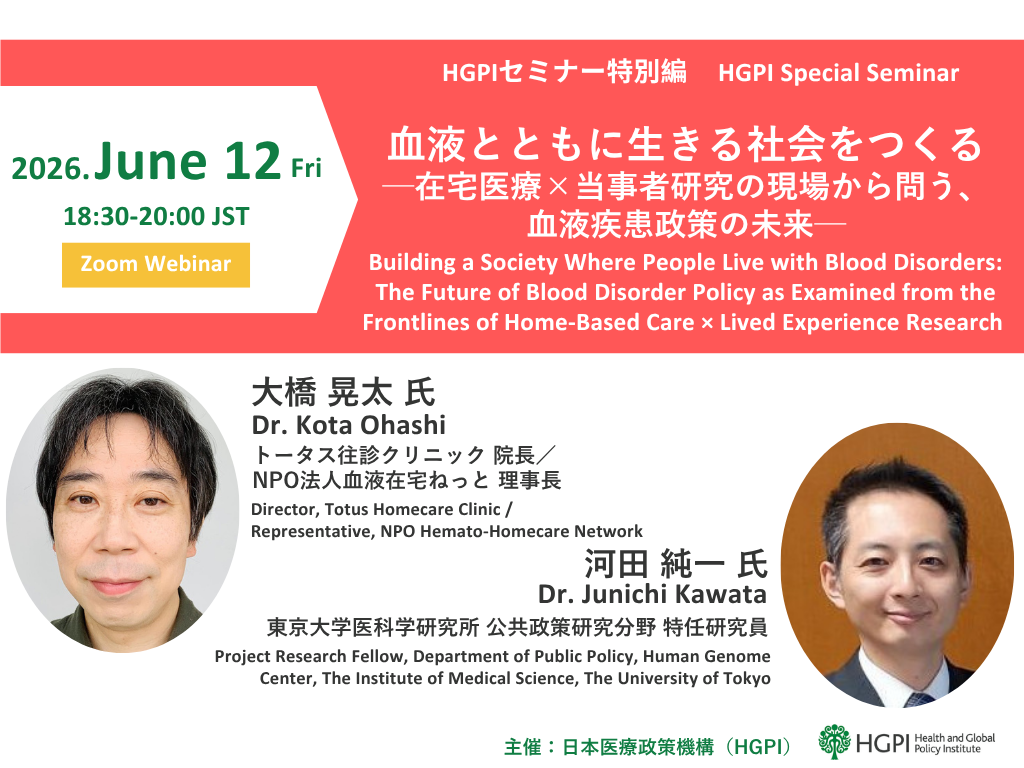
[Registration Closed] (Webinar) HGPI Special Seminar "Building a Society Where People Live with Blood Disorders: The Future of Blood Disorder Policy as Examined from the Frontlines of Home-Based Care × Lived Experience Research" (June 12, 2026)
-
2026-05-20
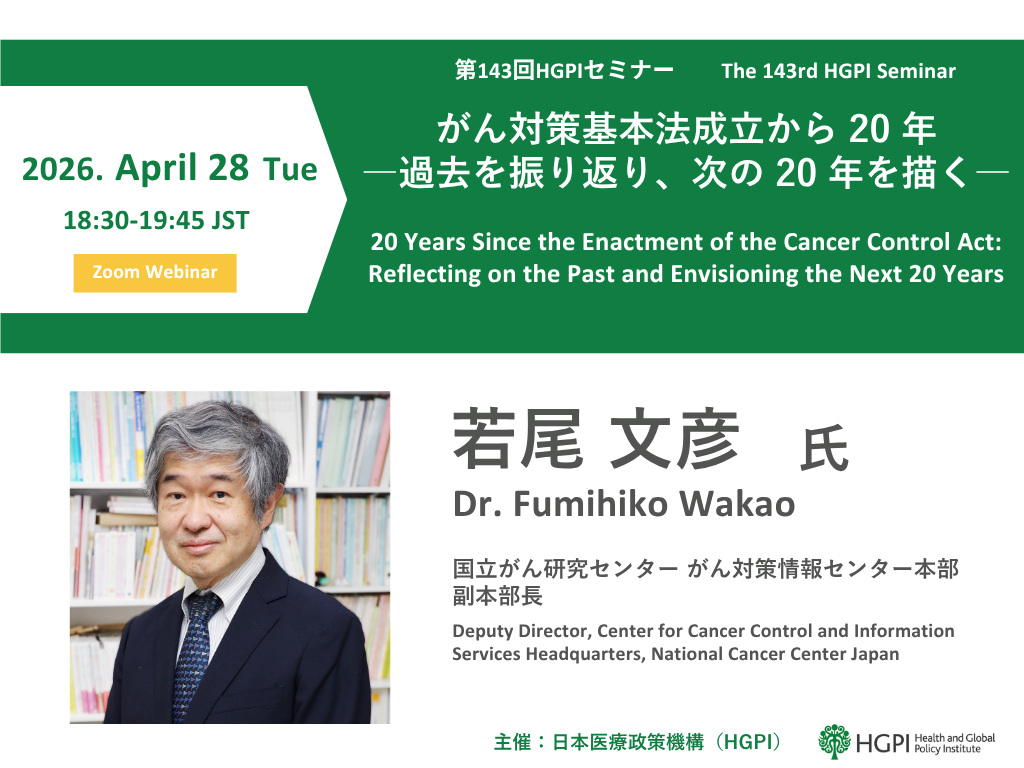
[Event Report] The 143rd HGPI Seminar “20 Years Since the Enactment of the Cancer Control Act: Reflecting on the Past and Envisioning the Next 20 Years” (April 28, 2026)
-
2026-03-11
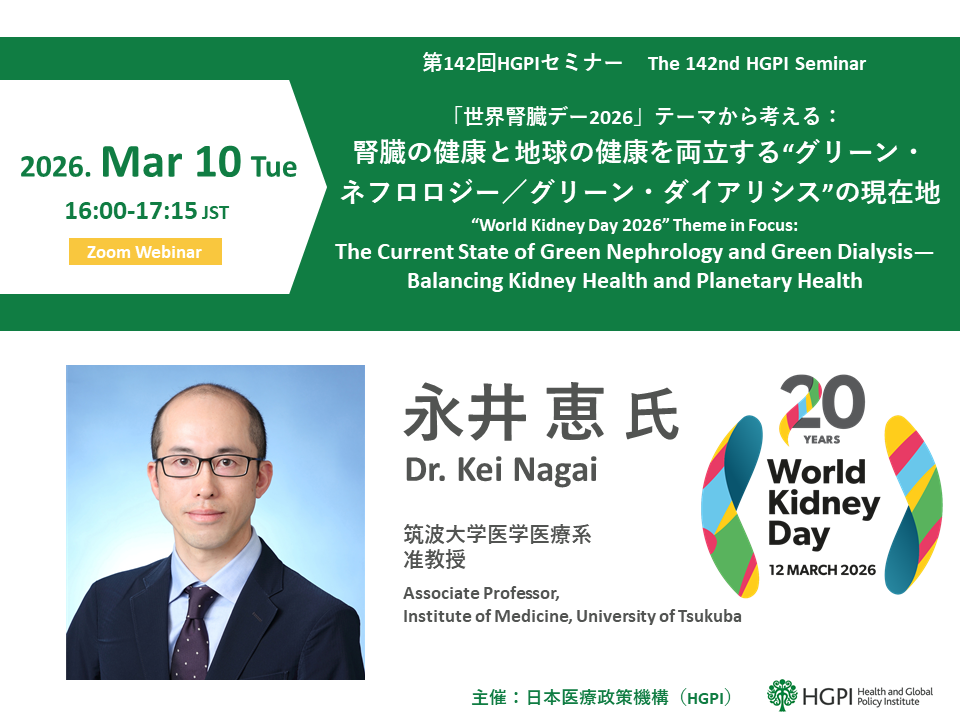
[Event Report] The 142nd HGPI Seminar “World Kidney Day 2026” Theme in Focus: The Current State of Green Nephrology and Green Dialysis—Balancing Kidney Health and Planetary Health (March 10, 2026)
-
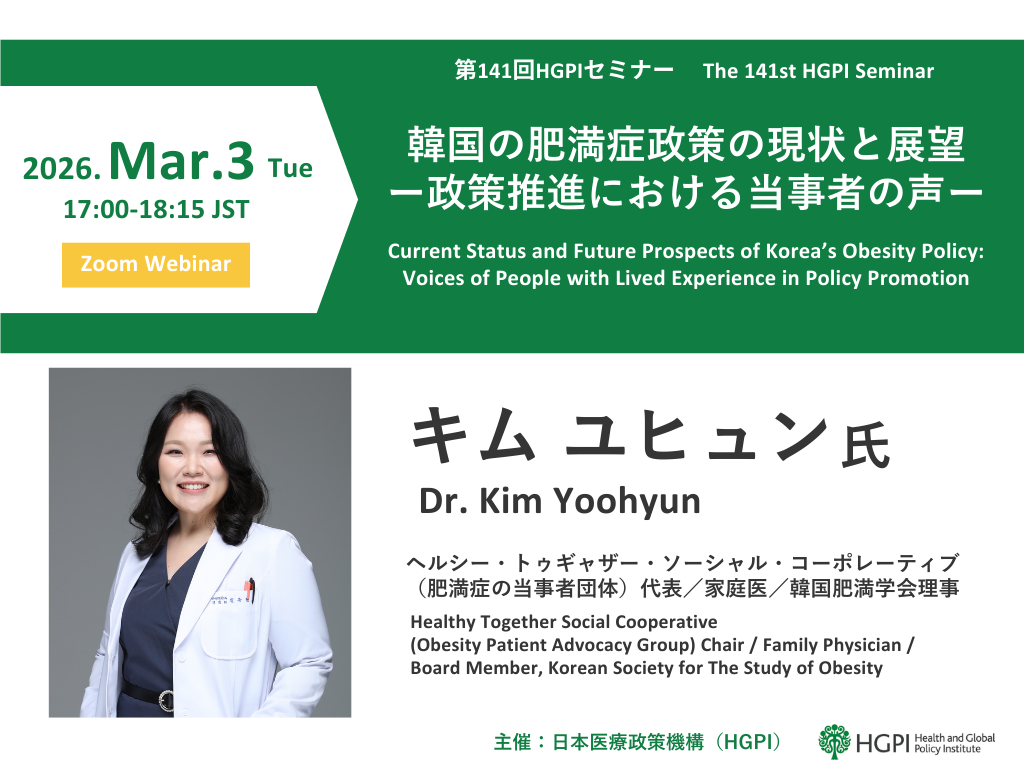
2026-04-06
[Event Report] The 141st HGPI Seminar “Current Status and Future Prospects of Korea’s Obesity Policy: Voices of People with Lived Experience in Policy Promotion” (March 3, 2026)
-
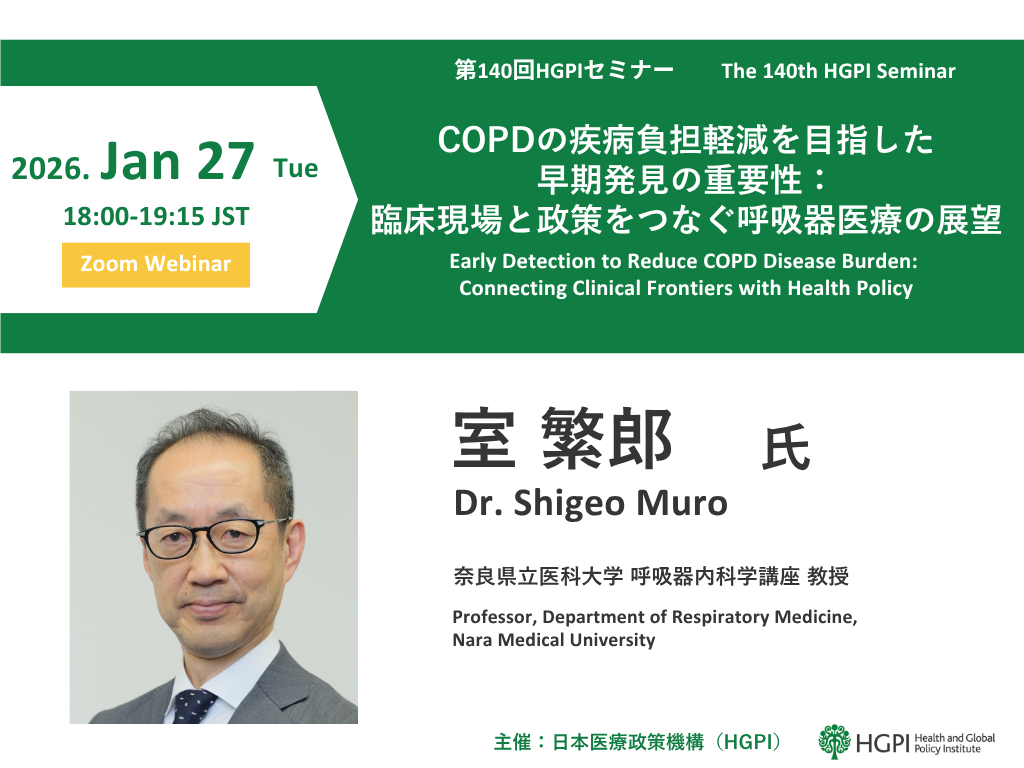
2026-03-26
[Event Report] The 140th HGPI Seminar “Early Detection to Reduce COPD Disease Burden: Connecting Clinical Frontiers with Health Policy” (January 27, 2026)
Top Research & Recommendations Posts
- [Policy Recommendations] Joint Statement “Protecting the Health of Both the Planet and People — A Japan-Model Planetary Health Strategy to Turn the Climate Crisis into an Opportunity for Health, the Economy, and Growth” (June 24, 2026)
- [Policy Recommendations] Toward Further Advancement of Measures Against Antimicrobial Resistance (AMR) (July 15, 2026)
- [Announcement] HGPI Joins the UHC2030 Task Force for the 2027 UN High-Level Meeting on UHC (July 6, 2026)
- [Research Report] Energy Conservation and Greenhouse Gas Emissions Reduction in Healthcare Facilities: Case Studies from New Construction and Facility Renewal (March 16, 2026)
- [Research Report] AMR Policy Update #6: The New Global Action Plan on AMR (Part 1)
- [Research Report] AMR Policy Update #7: The New Global Action Plan on AMR (Part 2)
- [Policy Recommendations] Hearing Loss Project “Recommendations on Coherent Countermeasures for Hearing Loss Throughout the Life Course: Building a Society Where Everyone Can Access Appropriate Hearing Care” (July 30, 2026)
- [Research Report] AMR Policy Update #9: Stockholm Residents’ Awareness and Practices in Returning and Recycling Pharmaceuticals: Findings from Local Interviews (July 15, 2026)
- [Policy Recommendations] Expectations for a System that Spans Diseases, Ministries, and Agencies for the Effective Promotion of Patient and Public Involvement (PPI) in Research and Development (June 30, 2026)
- [Activity Report] HGPI Contributed to the Development of the Civil 7 (C7) Global Health Working Group’s Climate and Health Thematic Brief for the G7 (June 25, 2026)
Featured Posts
-
2026-06-19
[Recommendations] Strengthening Epidemiology Education in the Veterinary Field for the One Health Era (June 19, 2026)
![[Recommendations] Strengthening Epidemiology Education in the Veterinary Field for the One Health Era (June 19, 2026)](https://hgpi.org/en/wp-content/uploads/sites/2/HGPI_eyecatch_20260619_AMR_Recommendations.png)
-
2026-07-21
[Announcement] Announcement of the 2nd Kiyoshi Kurokawa Award Recipient
![[Announcement] Announcement of the 2nd Kiyoshi Kurokawa Award Recipient](https://hgpi.org/en/wp-content/uploads/sites/2/Kiyoshi-Kurokawa-Award_2nd_eyecatch_web.jpg)
-
2026-07-22
[Registration Open] Second Session of the Planetary Health Academy (Starts September 2026)
![[Registration Open] Second Session of the Planetary Health Academy (Starts September 2026)](https://hgpi.org/en/wp-content/uploads/sites/2/HGPI_20260722_PLH-Academy-2.png)
-
2026-07-31
[Policy recommendation] Reliable Policy Implementation for Early Detection and Early Intervention of Chronic Kidney Disease (CKD) (July 31, 2026)
![[Policy recommendation] Reliable Policy Implementation for Early Detection and Early Intervention of Chronic Kidney Disease (CKD) (July 31, 2026)](https://hgpi.org/en/wp-content/uploads/sites/2/ckd-ncd-20260731-top_ENG.png)
-
2026-08-05
[Registration Open] (Webinar) The 4th J-PEP Seminar “The History of PPI in Japan and My Own PPI Journey” (September 30, 2026)
![[Registration Open] (Webinar) The 4th J-PEP Seminar “The History of PPI in Japan and My Own PPI Journey” (September 30, 2026)](https://hgpi.org/en/wp-content/uploads/sites/2/HGPI_20260930_The4th-J-PEPseminar.jpg)
